
Does refinement need a learned discriminator?
Recent advances in diffusion distillation have enabled high-quality image generation in only one or a few network function evaluations (NFEs). Despite their efficiency, aggressively distilled generators often retain a residual distribution gap from their multi-step teachers, motivating recent methods to introduce adversarial refinement with a learned discriminator. In this work, we ask whether such refinement necessarily requires a learned adversarial discriminator. We introduce FisherDistill, a simple alternative based on Fisher linear discriminant analysis. Using intermediate representations from the frozen teacher, we estimate the first- and second-order statistics of real and generated samples and derive a closed-form Fisher direction that maximally separates their feature distributions relative to within-class variation. This direction provides a lightweight refinement signal that complements the original distillation objective without requiring an additional adversarial discriminator or its optimization loop. Across multiple distillation frameworks, our approach consistently improves generation quality over their respective distilled baselines and substantially closes the gap to adversarially refined counterparts.
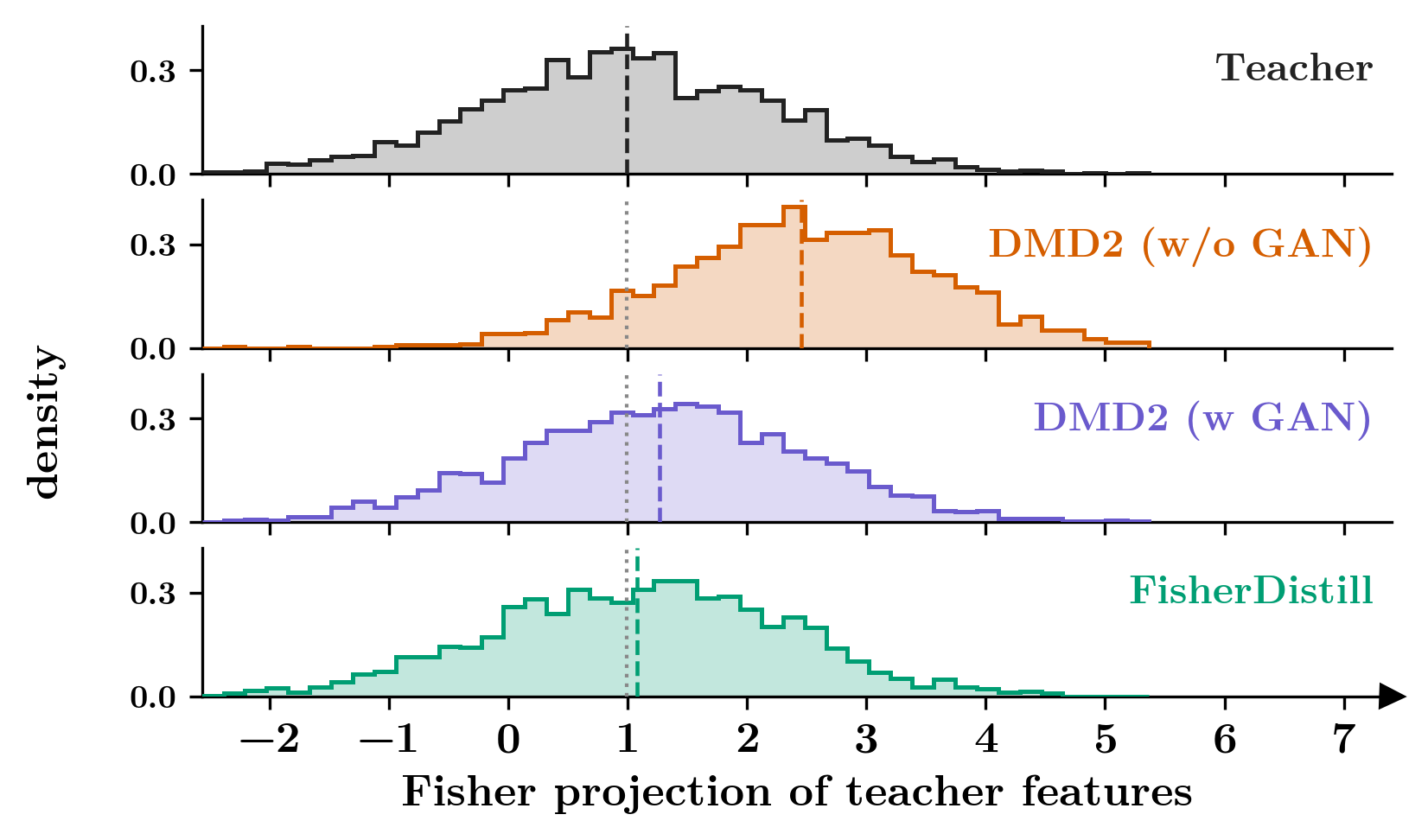
A closed-form critic in place of a GAN
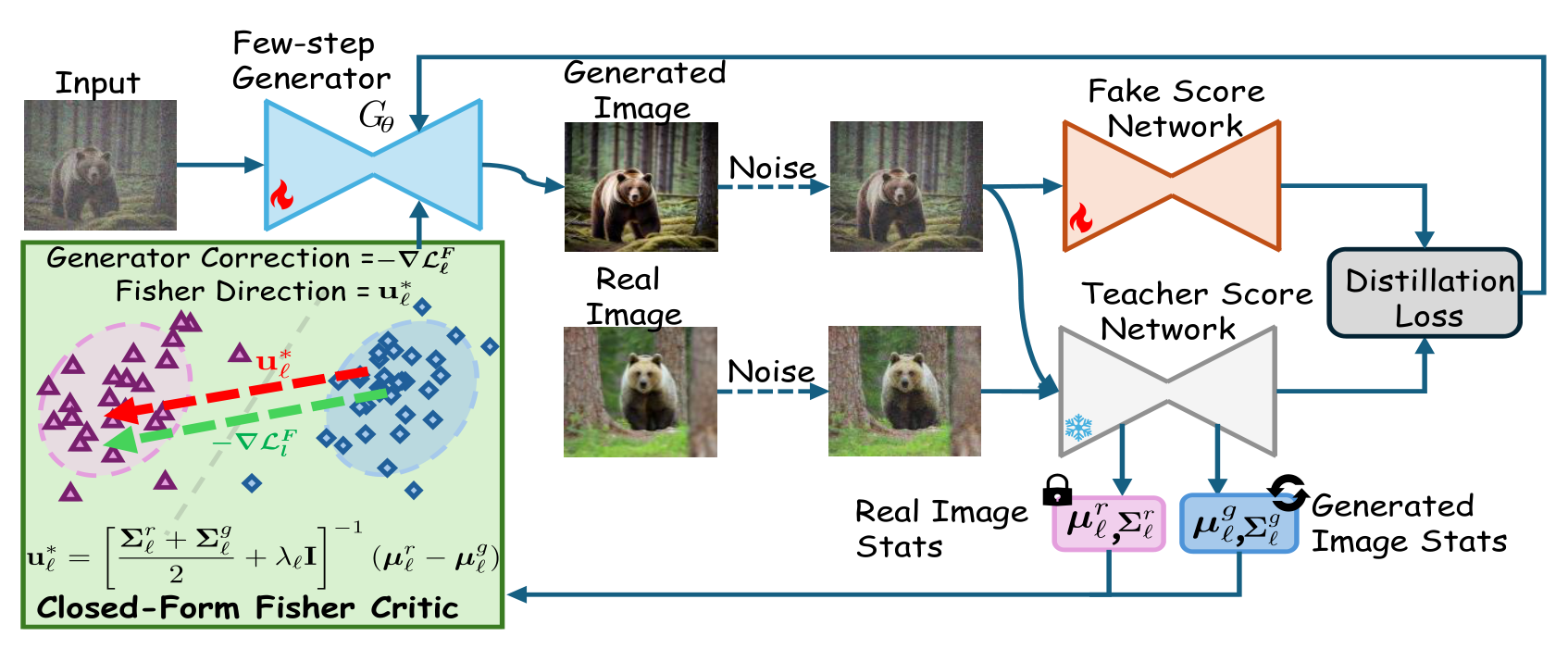
Closed-form Fisher critic
The residual gap is visible in the frozen teacher’s features (see the figure next to the abstract), so we build the critic there. At a fixed noise level tF, each sample is passed through the frozen teacher; for every selected layer ℓ the feature fℓ concatenates the per-channel spatial mean and standard deviation (or token statistics for DiTs).
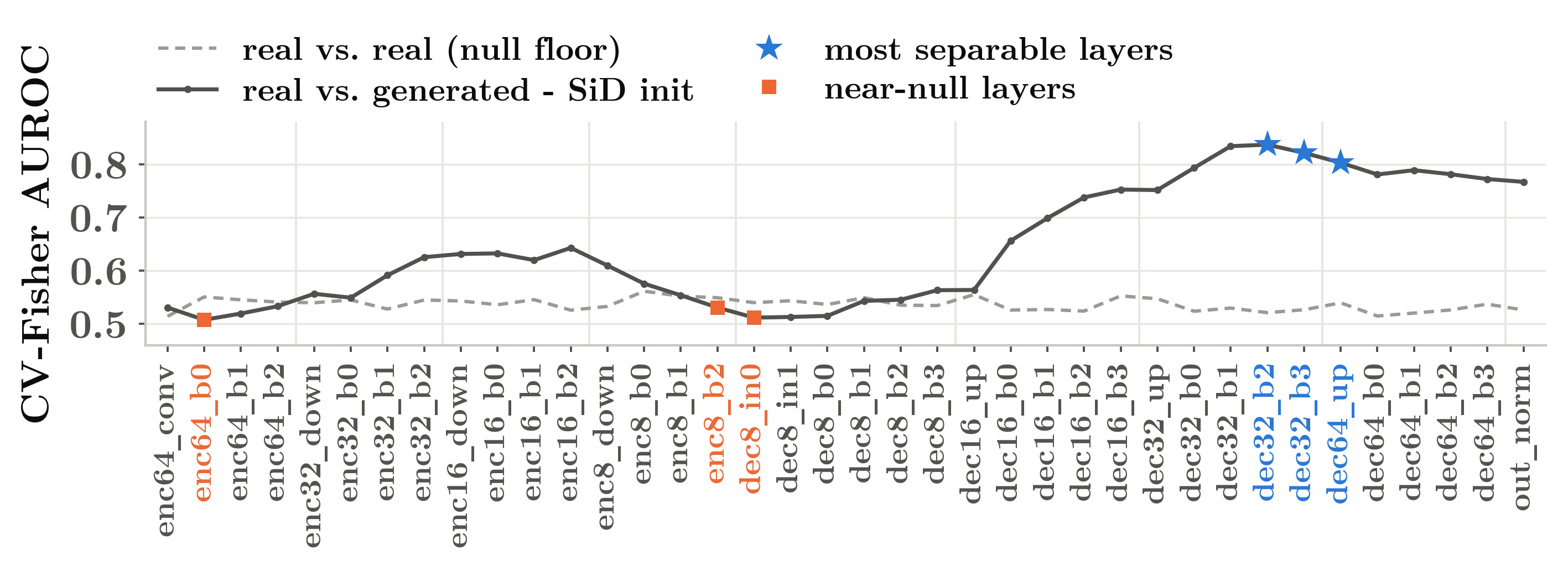
Where to read the teacher
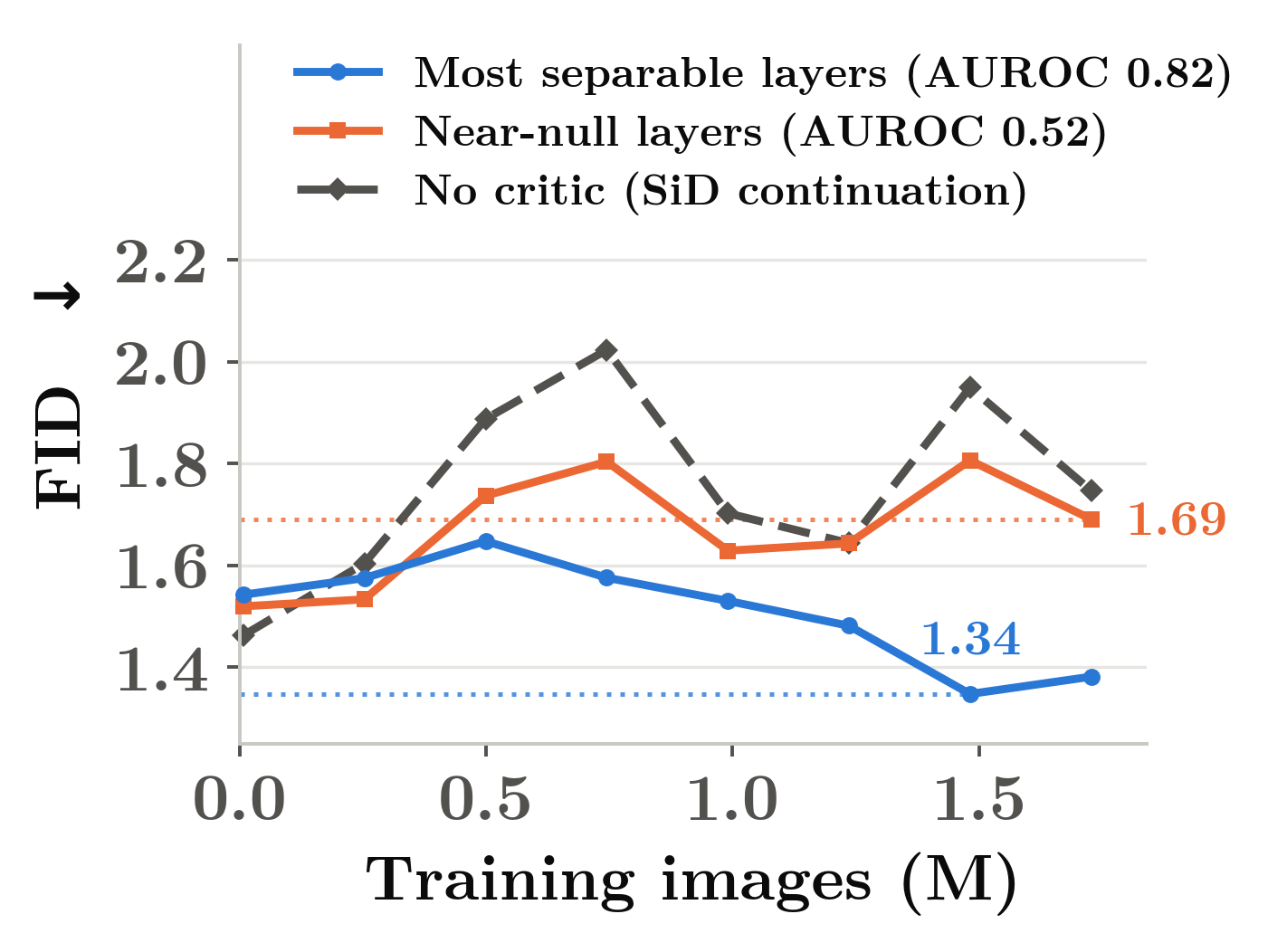
The critic is only as useful as the layers it reads. Held-out separability varies strongly across teacher layers, and it predicts which layers work.
Closing the gap to adversarial refinement, without the adversary
Each panel keeps the base framework, initialisation and budget fixed and changes only the refinement term. Lower FID is better.
FID per setting, each panel on its own scale starting at 0. GAN refinement is DMD2, SiD²A, 1.x-Distill Stage II and SiD²A-DiT respectively; all baselines trained with the official code under a matched budget. Each group uses its base framework's evaluation protocol.
Full tables (precision/recall, CLIP, GenEval, aesthetics, preference)
Class-conditional ImageNet 64×64, EDM teacher
| Method | NFE | FID ↓ | Prec. ↑ | Rec. ↑ |
|---|---|---|---|---|
| EDM teacher (VP, SDE) | 511 | 1.32 | ||
| DMD-based | ||||
| DMD | 1 | 2.64 | 0.76 | 0.59 |
| DMD2† (GAN) | 1 | 1.42 | 0.74 | 0.60 |
| RealUID† | 1 | 3.07 | 0.74 | 0.58 |
| FisherDistill | 1 | 1.40 | 0.74 | 0.62 |
| SiD-based | ||||
| SiD (α = 1.2) | 1 | 1.54 | 0.74 | 0.63 |
| SiD²A† (GAN, α = 1.0) | 1 | 1.31 | 0.74 | 0.62 |
| RealUID† | 1 | 1.45 | 0.74 | 0.62 |
| FisherDistill | 1 | 1.34 | 0.76 | 0.63 |
Text-to-image, zero-shot COCO-2014
| Method | NFE | FID ↓ | CLIP ↑ | GenEval ↑ | Aesth. ↑ | HPSv2 ↑ | ImgRwd ↑ | PickScore ↑ |
|---|---|---|---|---|---|---|---|---|
| Stable Diffusion v1.5 · DMD2 | ||||||||
| SD v1.5 teacher | 50 | 8.60 | 0.310 | 0.442 | 5.466 | 0.267 | 0.096 | 20.61 |
| DMD | 1 | 9.28 | 0.302 | 0.347 | 5.333 | 0.255 | −0.410 | 20.01 |
| DMD2† (GAN) | 1 | 8.58 | 0.300 | 0.343 | 5.414 | 0.256 | −0.378 | 20.00 |
| RealUID† | 1 | 9.37 | 0.303 | 0.352 | 5.346 | 0.256 | −0.332 | 20.06 |
| FisherDistill | 1 | 8.46 | 0.304 | 0.348 | 5.393 | 0.257 | −0.350 | 20.07 |
| SD3-Medium · 1.x-Distill | ||||||||
| SD3-Medium teacher | 28 | 23.39 | 0.330 | 0.708 | 5.370 | 0.294 | 1.027 | 22.50 |
| 1.x-Distill Stage I† | 2 | 32.35 | 0.329 | 0.651 | 5.283 | 0.284 | 0.985 | 22.15 |
| 1.x-Distill Stage II† (GAN) | 2 | 30.20 | 0.330 | 0.655 | 5.430 | 0.288 | 0.998 | 22.59 |
| RealUID† | 2 | 34.03 | 0.326 | 0.641 | 5.101 | 0.279 | 0.862 | 21.99 |
| FisherDistill | 2 | 29.54 | 0.330 | 0.682 | 5.483 | 0.294 | 1.059 | 22.37 |
| SANA 0.6B · SiD-DiT | ||||||||
| SANA 0.6B teacher | 20 | 26.38 | 0.338 | 0.651 | 5.730 | 0.311 | 0.999 | 22.50 |
| SiD-DiT | 1 | 28.94 | 0.323 | 0.594 | 5.751 | 0.278 | 0.709 | 21.51 |
| SiD²A-DiT† (GAN) | 1 | 34.13 | 0.298 | 0.486 | 5.383 | 0.244 | 0.287 | 21.00 |
| RealUID† | 1 | 31.87 | 0.320 | 0.590 | 5.740 | 0.274 | 0.688 | 21.46 |
| FisherDistill | 1 | 25.24 | 0.326 | 0.597 | 5.744 | 0.286 | 0.820 | 21.80 |
| SANA 1.6B · SiD-DiT | ||||||||
| SANA 1.6B teacher | 20 | 26.83 | 0.334 | 0.652 | 5.840 | 0.312 | 1.054 | 22.56 |
| SiD-DiT | 1 | 28.86 | 0.325 | 0.581 | 5.881 | 0.285 | 0.880 | 21.71 |
| SiD²A-DiT† (GAN) | 1 | 28.58 | 0.323 | 0.615 | 5.889 | 0.289 | 0.883 | 21.81 |
| RealUID† | 1 | 34.28 | 0.322 | 0.578 | 5.916 | 0.279 | 0.867 | 21.60 |
| FisherDistill | 1 | 26.73 | 0.326 | 0.603 | 5.816 | 0.289 | 0.884 | 21.73 |
† Reproduced with the official code under a matched training budget. Compare only within a group.
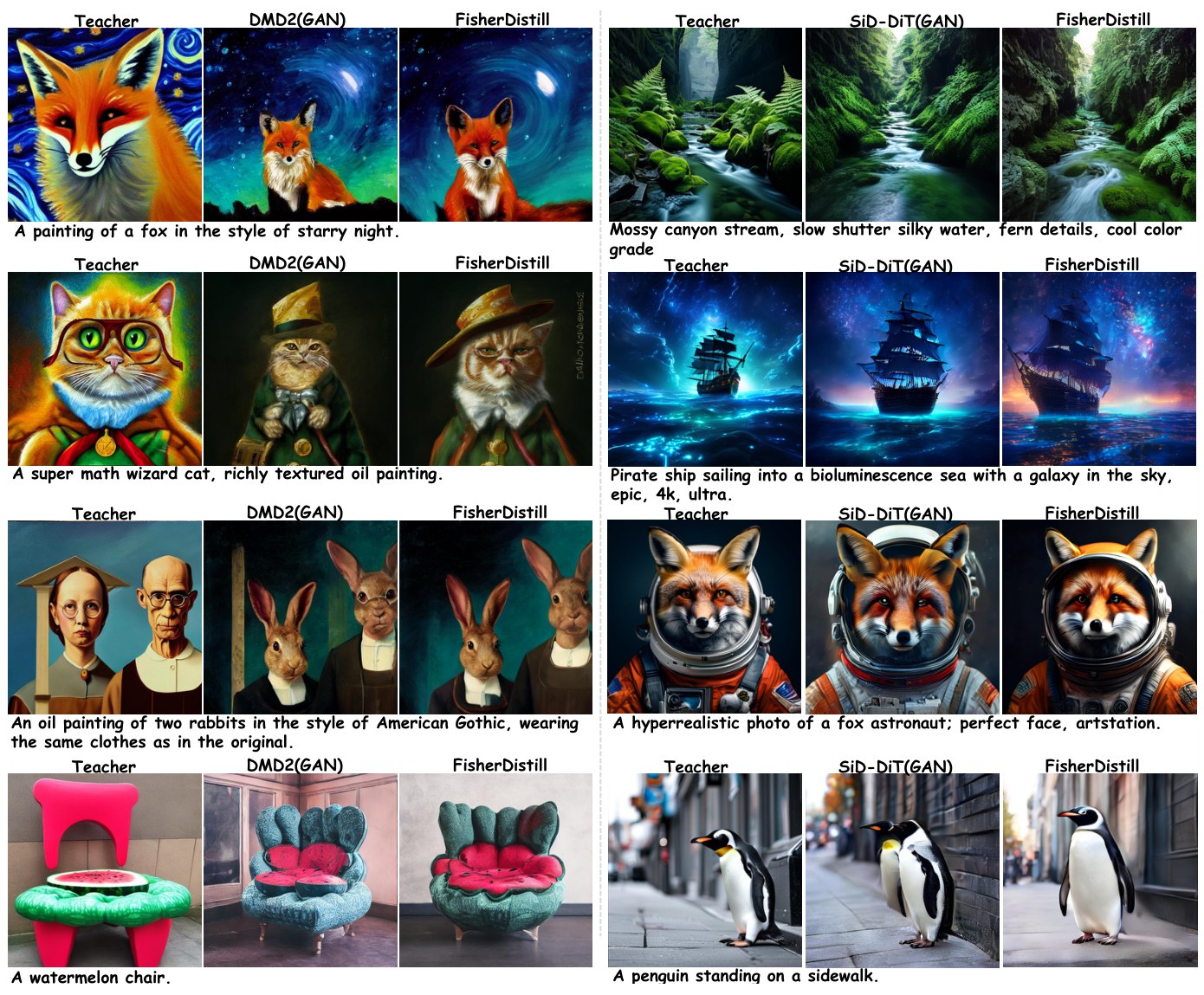
One step, side by side
Text-to-image
ImageNet 64×64, uncurated, one step
One sample per class for classes 0–99, identical noise across models.

BibTeX
@article{bhosale2026fisherdistill,
title = {FisherDistill: Diffusion Distribution Distillation via Closed-Form Fisher Critics},
author = {Bhosale, Mahesh and Zhai, Yuanhao and Lyu, Siwei and Yuan, Junsong and Doermann, David and Chen, Defang},
journal = {arXiv preprint},
year = {2026}
}The arXiv identifier will be added once the preprint is live.